Europe looks like one connectivity zone from a plane window, and for a stretch of it, it behaves like one: cross from France into Germany and your phone barely notices. But "Europe" is actually three overlapping maps — the EU, the Schengen open-border area, and the much narrower zone where "roam like at home" pricing applies — and they don't line up. The places where they diverge are where roaming bills happen, and most of them are smaller and stranger than the UK or Switzerland.
Three maps, not one
Schengen is about border control: cross between member countries without a passport check. The EU is political and economic membership. "Roam like at home" is a telecom rule that lets a SIM from an EU or EEA country use its home data allowance elsewhere in the EU/EEA at no extra charge, subject to fair-use caps. Only the third map decides your phone bill, and it's the smallest of the three. A country can be in Schengen and still charge full roaming rates; a country can be nowhere near Schengen and still be inside the EU. Assuming one map tells you about the others is the mistake, and it happens quietly because most of the time, in most of western Europe, the three maps do overlap.
The UK and Switzerland are the two examples most travelers already half-know — Brexit pulled the UK out of all three maps at once, and Switzerland has never been in the EU or EEA despite sitting in the middle of it. We've covered both in detail: the Brexit roaming trap and what a Swiss video call actually costs. What's less well known is that non-EU pockets aren't limited to those two — some are microstates you'd barely notice you'd crossed into, and one is an entire region.
The microstates hiding inside the EU
Andorra sits in the Pyrenees between France and Spain; San Marino and Vatican City sit entirely inside Italy; Monaco is a few streets wrapped in French territory. None of the four is an EU or EEA member, which means none of them is covered by "roam like at home" — even though you can cross into most of them without so much as a checkpoint to slow you down. That's exactly the trap: there's no border post to remind you the roaming rules just changed, only the network on your phone quietly switching to a foreign one.
San Marino is the clearest case — a walled hilltop city-state you can visit as a day trip from the Adriatic coast without a single formal border, and one where your home EU allowance stops applying the moment your phone latches onto a Sammarinese tower. The other three are smaller still, but the mechanism is identical: geography says Europe, telecom regulation says something else.

The Western Balkans: a whole non-EU region
Zoom out from the microstates and there's a much bigger pocket: Albania, Bosnia and Herzegovina, Kosovo, Montenegro, North Macedonia and Serbia — six increasingly popular destinations, none of them EU members, so "roam like at home" doesn't reach any of them for an EU-based SIM. What the region does have is its own deal: the Western Balkan parties signed a regional agreement to cut roaming charges between themselves, mirroring the EU's approach on a smaller scale. It's a real reduction in what these countries charge each other's subscribers — it does nothing for a SIM issued in Madrid, Berlin or Warsaw, which still pays whatever that home operator has decided a Balkan trip costs, if it bothers to include one at all.
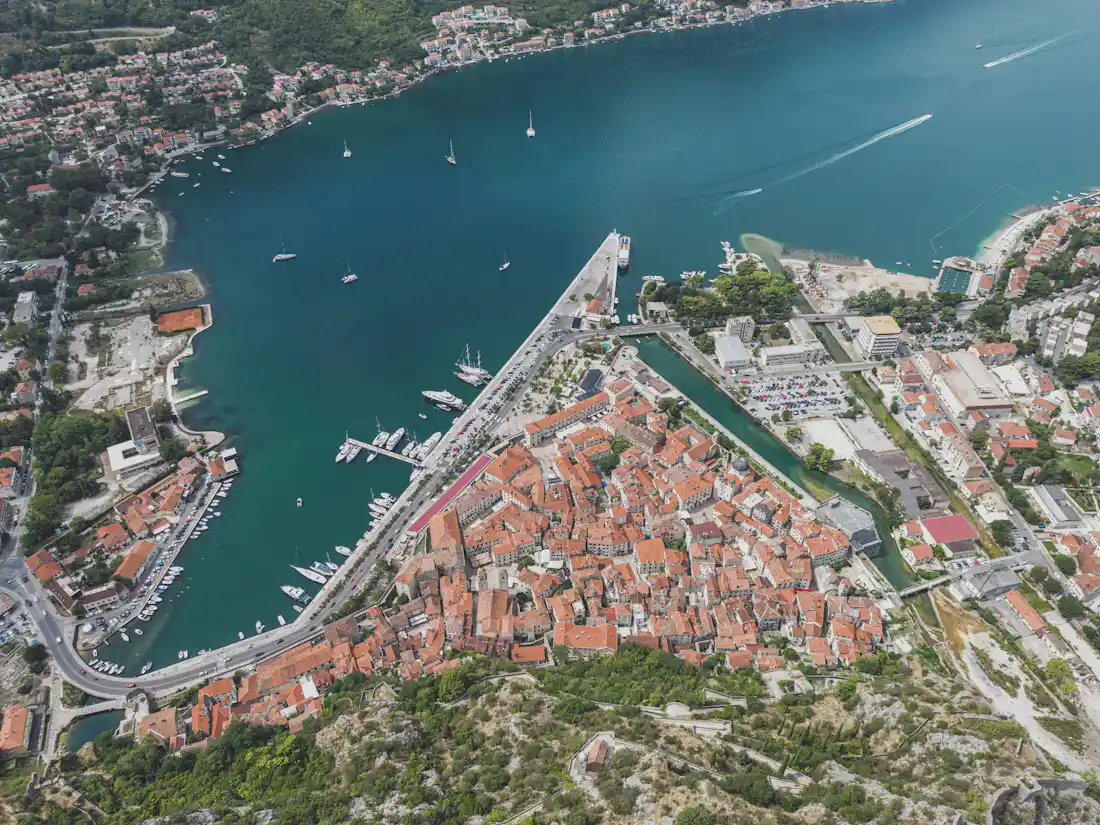
Coastal Montenegro (Kotor, Budva), Sarajevo, Belgrade and the Albanian Riviera are all firmly on the growing summer-and-shoulder-season circuit — which means more travelers than ever are carrying an assumption from the EU leg of their trip into a region where it simply doesn't hold.
The exception worth knowing: EEA is covered
Not every non-EU country is a trap. Norway, Iceland and Liechtenstein aren't EU members either, but as members of the European Economic Area they're folded into the same roaming regulation — an EU SIM behaves there exactly as it does inside the EU. It's the reminder that "non-EU" isn't a shortcut for "expensive"; the only map that actually matters is the narrow one, and it's worth checking per destination rather than assuming from the continent.
What actually works everywhere
The reliable fix isn't memorizing which of the three maps a given country sits on — it's not depending on any of them. A VamosData eSIM is priced and bought before you fly, for the specific country or region you're visiting, so it doesn't matter whether that destination happens to be EU, EEA, Schengen, all three, or none:
- Check your phone supports eSIM on the device checker.
- Pick a plan for exactly where you're headed — microstate, Balkan itinerary or otherwise — on destinations.
- Install it ahead of time via the iOS or Android guide; most plans only start counting from first connection, so installing early costs nothing.
- Keep your home SIM for calls and texts, with its data roaming switched off, exactly as in the avoiding roaming charges checklist.
The three maps of Europe will keep not lining up. Your data plan doesn't have to care which one you just crossed.