September does something quietly generous to Europe. The crowds thin, the heat finally breaks, and the trains empty out. It is the best month of the year to cross the continent by rail — and the month when a lot of travellers discover that a train is a completely different connectivity problem from a flight. You don't land somewhere and sort out data once. You spend nine hours moving through three countries, and your phone has to keep up the whole way.
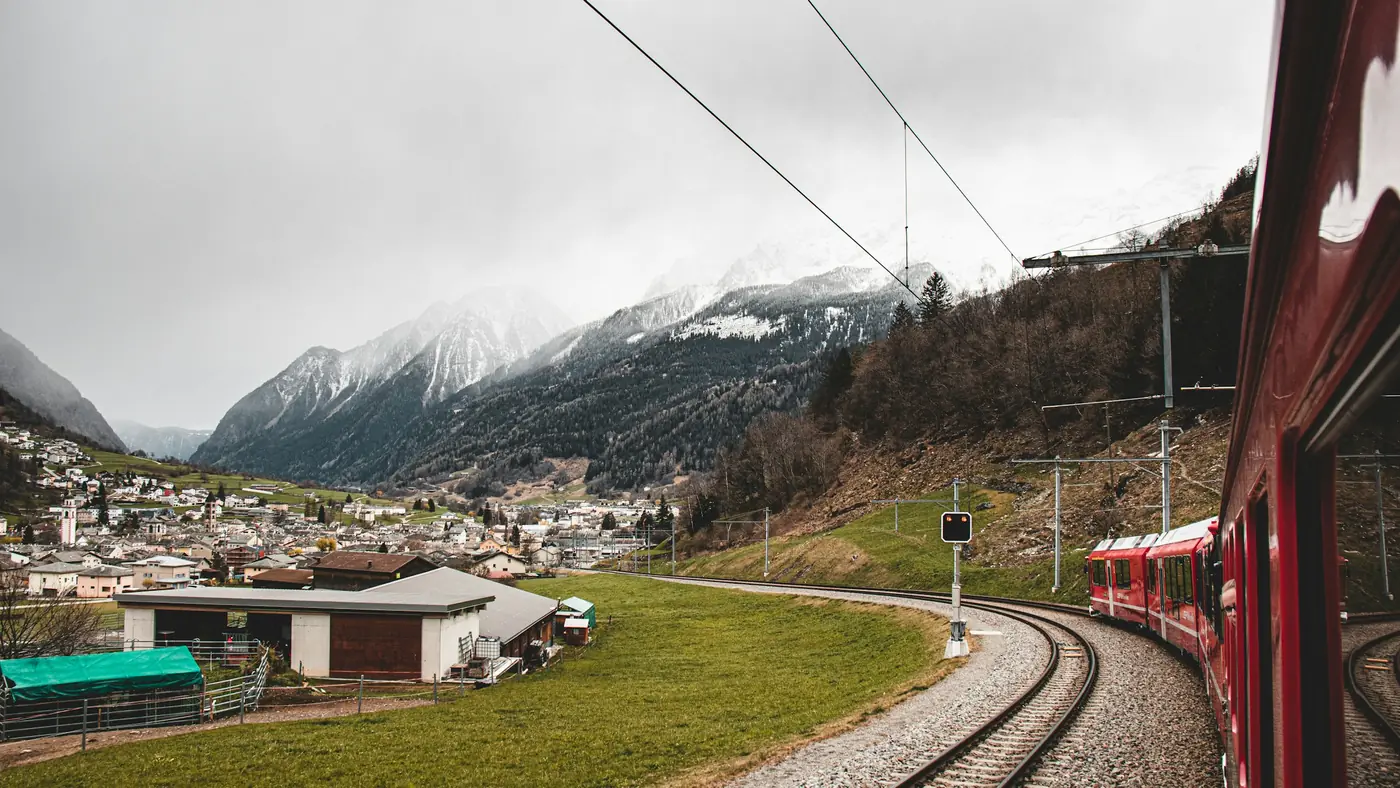
Why September pulls people onto the rails
Shoulder season rewards the slow route. Seats are easier to find than in August, the scenic lines through the Alps and along the Italian lakes are pleasant rather than punishing, and a carriage at 22 degrees beats a motorway at 38. It's the same logic behind picking a cooler destination in the first place — except that on a train, the journey is the point.
It also means more borders. A September rail itinerary tends to stitch four or five countries into one trip, which is where the connectivity part gets interesting.
A train is not a flight
Flying is one clean break. Airplane mode goes on, you land, and you connect once — the arrival problem we picked apart in your first 30 minutes in a new country.
Rail is continuous. Your phone hands over from mast to mast for hours, and at each border it has to find and register on an entirely new national network. In the Schengen area nothing announces this. There's no passport check, no gate, often not even a sign — the carrier name at the top of your screen changes and that's the whole ceremony. Your phone usually knows you've left the country before you do.
Most of the time this is invisible and fine. The two places it isn't: where there's no network at all, and where the network you've just joined bills differently.
Onboard Wi-Fi is a captive portal with a view
The pitch is that you don't need mobile data because the train has Wi-Fi. In practice:
- It usually isn't a separate pipe. Onboard Wi-Fi is typically backhauled over the same mobile networks the train is rolling through. When the train hits a dead stretch, the Wi-Fi dies with it.
- It's shared with everyone in the carriage, on a route where half the passengers are working.
- It wants a portal login, sometimes a code, sometimes a seat number.
- It often stops at the border, or at least stops being the same service.
Treat it as a bonus for messages and email. Don't make it the thing standing between you and the ticket barrier at the other end.
The stretches where nothing works
Long tunnels and deep valleys are the honest gaps. Some major tunnels have been fitted with mobile coverage and some haven't, and rural mountain track frequently hasn't — it varies by line, country and operator, so there's no rule that holds across a whole itinerary.
The fix isn't a better SIM, it's timing. Anything you'll need at the far end should already be on the phone before you leave the platform:
- tickets and seat reservations, downloaded or in your wallet app rather than sitting in an email
- an offline map of the arrival city
- your accommodation address, screenshotted
- if you're travelling on a mobile rail pass, activate the travel day while you still have a connection
The border that quietly bills you
Within the EU/EEA, "roam like at home" generally lets your domestic allowance travel with you, subject to fair-use caps that vary by operator. Rail routes are very good at wandering out of that zone without telling you.
Switzerland is the classic. It's in neither the EU nor the EEA, so the price caps simply don't apply — and half the good alpine routes run through it, including trains between Germany, France and Italy. One video call on the wrong line is enough to produce a memorable bill. The UK sits outside the arrangement too, and several operators have reintroduced roaming charges since. The full map of where the rules stop is in how to avoid roaming charges in Europe.
This is the seam a VamosData eSIM is genuinely good at closing. One plan covering your whole route keeps you on a single prepaid allowance across every border on the itinerary, so crossing into Switzerland at lunchtime doesn't change what you're paying. Check what covers your particular route on destinations — some plans are single-country, others regional, and a multi-border trip is exactly the case for the latter.
Before you board
- Check your phone supports eSIM with the device checker.
- Pick a plan that covers the countries your route actually passes through, on destinations.
- Install your VamosData eSIM at home on Wi-Fi (iOS / Android) — installing doesn't start the plan.
- Set mobile data to the VamosData line and turn data roaming on for it; leave your home line's data roaming off so it can't quietly take over.
- Download tickets, offline maps and anything you'd hate to lose in a tunnel.
- Bring a power bank. Seat sockets exist on many trains and are occupied on most of them.
The romance of European rail is that you can doze off in one country and wake up in another. The unromantic version is that your phone does the same thing, several times, without mentioning it. Sort that out on the platform and the rest of September is just scenery.