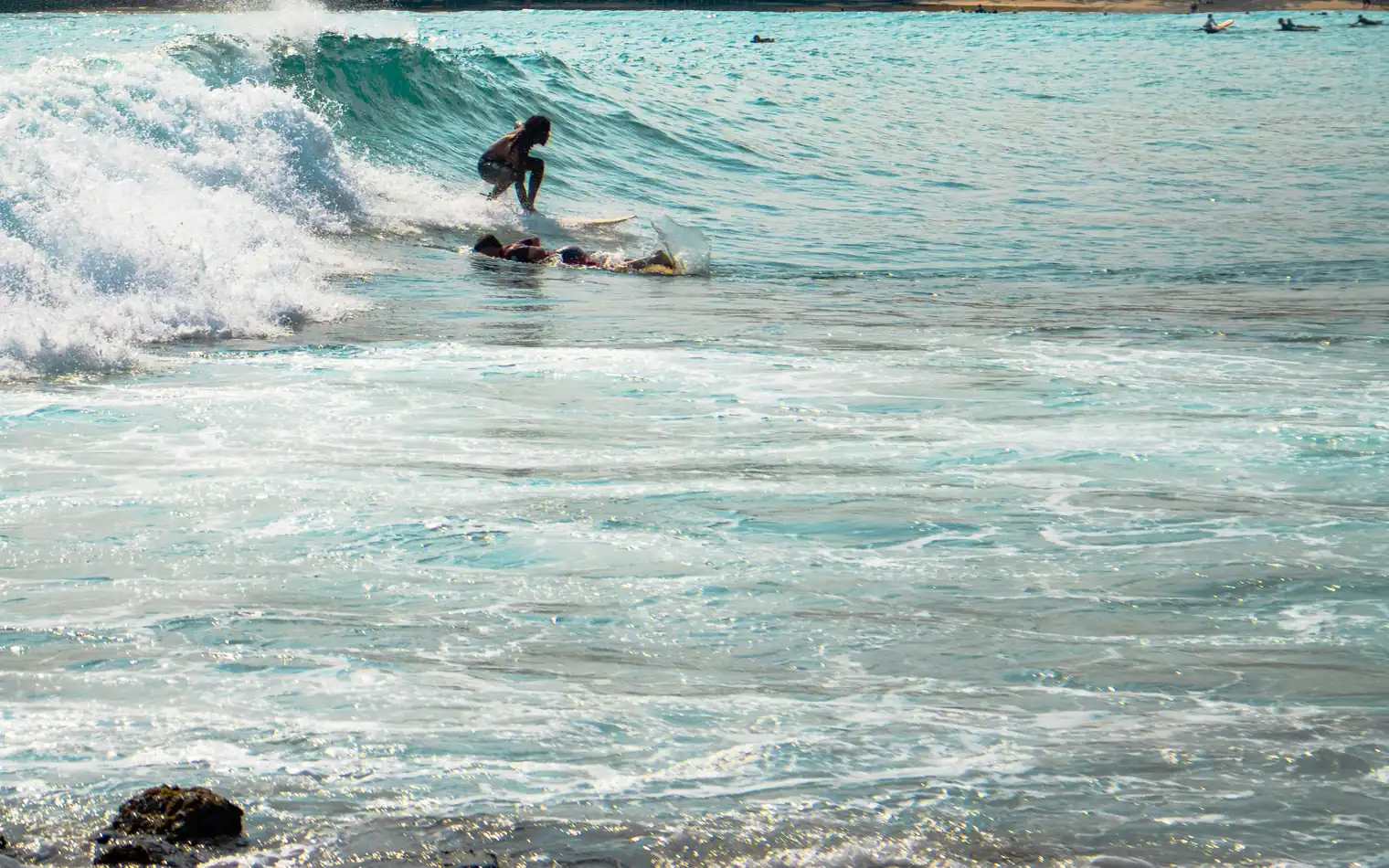
Sri Lanka's southern coast has become one of Asia's easiest places to live well and work cheaply: Weligama for beginner waves, Ahangama for the long-stay crowd, Hiriketiya for the horseshoe bay everyone photographs. The tuk-tuk is the commute, and since February 2026 there is an actual visa for staying. The part nobody puts in the caption: the island's electricity grid has had a rough couple of years, and your working day runs on it.
The three towns, and what each does to your day
They sit along 40-odd km of coast road, close enough to scooter between and different enough to matter.
Weligama is the practical base: banks, a market, the big learner bay, and the densest supply of air-conditioned rooms with a plug socket. It is also the loudest.
Ahangama is where much of the long-stay crowd has settled — quieter lanes, cafes along the Galle Road, a few coworking spaces that come and go, reef breaks for people who already surf.
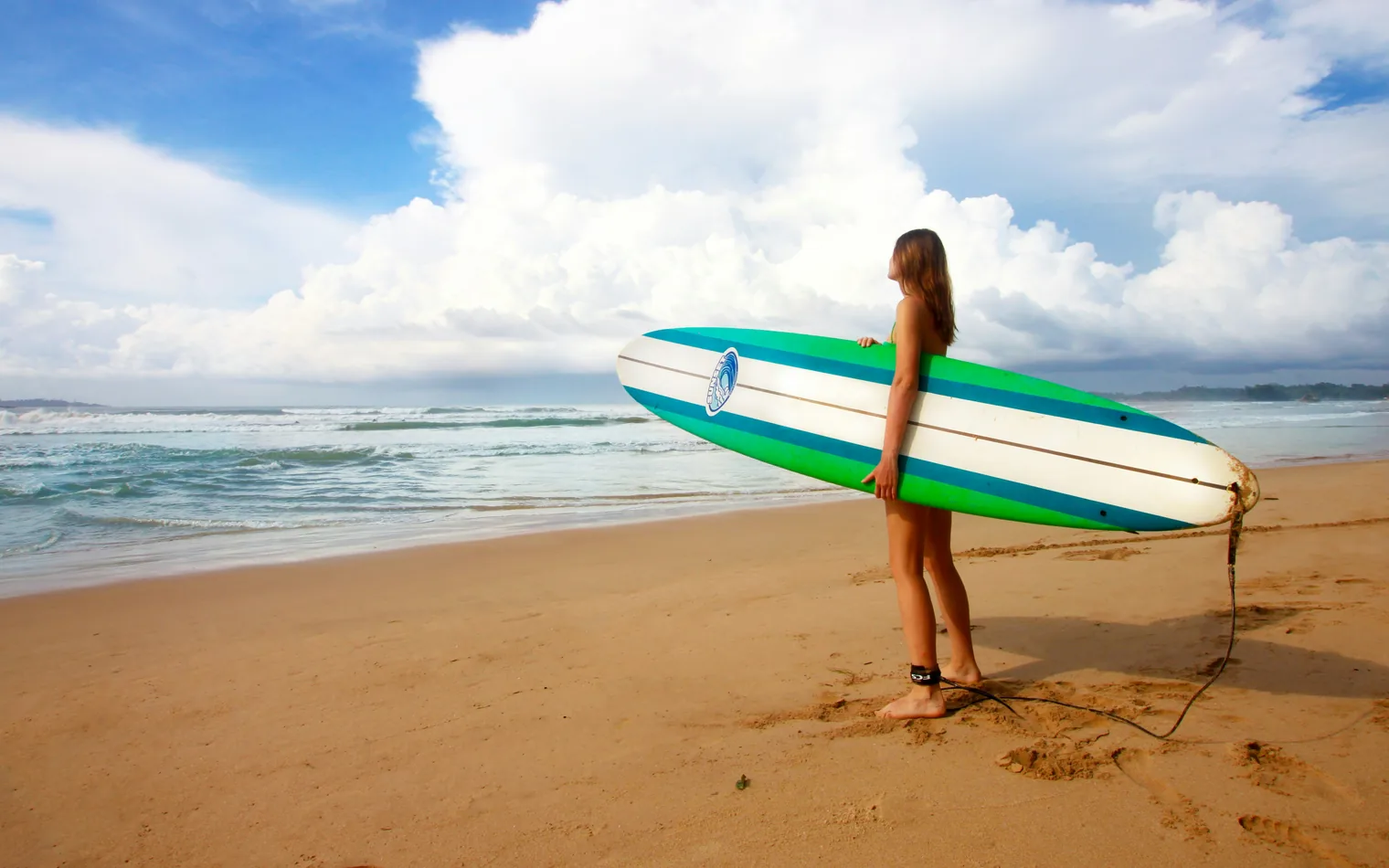
Hiriketiya, past Dikwella, is the smallest and most seductive: one tight bay, a few cafes, very little infrastructure. Desk space is thin, so a heavy call day means riding out to Dikwella or back up the coast.
Whatever the listing says, test the connection at the hour you actually work, and ask one question before committing to a month: what happens here when the power goes? Nothing, a UPS, solar, a generator — that answer is the real spec sheet.
The visa changed, so stays got longer
Two things happened in 2026, and they stack:
- A free 30-day tourist ETA for nationals of 40 listed countries, since 25 May 2026. The fee is waived; the pre-arrival approval is not.
- A digital nomad visa, launched February 2026: one year, renewable, for income earned outside Sri Lanka, with health insurance required.
Reported income thresholds and fees have moved since launch, and sources disagree with each other, so treat every figure you read — this post included — as a prompt to check the Department of Immigration and Emigration directly. None of this is legal advice.
Why the grid is the thing to plan around
Not a rumour, and not the 2022 fuel crisis either. Through 2026, supply has been wobbly:
- On 17 October 2026 the entire grid went down. Restoration took over six hours, and the system operator asked rooftop solar owners to disconnect so it could be brought back.
- Days later, after a major coal unit became unavailable, the utilities regulator approved one-hour rotational cuts island-wide, to be applied only if demand required it.
- The structural reason is unusual: rooftop solar has grown past roughly 3,000 MW while midday demand sits around 2,000–2,500 MW, making the daytime grid hard to balance. Sunny hours are not automatically safe hours.
Day to day, what hits your deadline is smaller: a monsoon squall, a feeder fault, roadworks through the village. The street comes back in an hour; the guesthouse router takes its time.
Fibre is one wire, and it runs past a lot of shovels
Fixed broadband here is good when it works — and it is a single last-mile line into one building. Roadworks and storm damage cut it, and nothing in the room routes around it. Further out, the island is fed by a handful of submarine cables; when one is damaged, traffic reroutes over the others and the evening gets slower rather than darker.
Mobile data is the part that holds up. Opensignal's February 2026 Sri Lanka report, on measurements from October to December 2025, gave Dialog the most awards, including consistency and reliability, and SLT Mobitel all four speed awards; both launched commercial 5G in December 2025. Background, not a promise about your bay.
Carry two routes, not one
| Route | Good for | Weak spot |
|---|---|---|
| Cafe or guesthouse Wi-Fi | Big uploads, backups, long focused sessions | One shared line that dies with the building's power |
| Your phone as a hotspot | Calls, deadlines, anything with witnesses | Uses your data allowance and your battery |
| A local SIM bought on arrival | Long stays, local calls, domestic apps | A counter, your passport, an unfamiliar top-up app |
A VamosData eSIM for Sri Lanka installs as a second profile, so your own number stays live for bank codes while the travel line carries the work — and it is on the phone before you land. Which network it attaches to is a roaming matter and can change, so treat it as a genuinely independent second route. Plan sizes and prices live on destinations.
A power-cut routine that holds
- Keep a charged power bank at the desk, big enough to refill a phone twice. Check the airline rules first.
- Switch to the hotspot early. Your laptop battery is the UPS; don't spend it waiting for the router.
- Park the phone where the signal is — a window ledge, a balcony rail. The laptop only has to reach the phone.
- Kill photo backup and cloud sync. Tethered, they eat a working month of data in an afternoon.
- Size the plan for a working month, not a holiday week — our day-by-day data breakdown puts video calls at the heavy end.
Before you fly
- Check your handset supports eSIM on the device checker, and that it is carrier-unlocked.
- Pick a Sri Lanka plan from destinations and install it at home over Wi-Fi with the iOS or Android guide — installing a profile needs a connection you won't have at the airport.
- Turn data roaming on for your travel eSIM, and off for your home SIM.
- Practise the hotspot once, laptop paired, before you need it.
- Ask your accommodation, in writing, what backs up the router.
Working from the south coast is not about finding the villa with flawless fibre. It is about assuming the lights will go out the week you have a launch, keeping a charged second route in your pocket, and spending the saved panic on the 6am surf. For the same problem on another island, read our Phu Quoc remote-work guide.